


Page 8 - reflections_dyslipidaemia_newsletter5_2023
P. 8
REFLECTIONS
                                                                                                                   Dyslipidaemia
     Dyslipidaemia Global Newsletter #5 2023


     Association between achieved low-density lipoprotein cholesterol levels and long-

     term cardiovascular and safety outcomes: An analysis of FOURIER-OLE.
                                                                                                                   Dyslipidaemia
     Gaba P, et al. Circulation. 2023 Apr 18;147(16):1192-1203.

     Lowering LDL-C levels is a cornerstone of
     ASCVD risk reduction; however, the benefits
     and safety of very low LDL-C (10–40 mg/dL) has
     emerged as a key question.

     The Further Cardiovascular Outcomes Research
     With PCSK9 Inhibition in Subjects With Elevated
     Risk (FOURIER) trial examined 27,564 patients
     with stable ASCVD and randomized them to
     evolocumab, a PCSK9i, or placebo, with a
     median follow-up of 2.2 years. In the open-
     label extension (FOURIER-OLE), 6635 of
     these patients were transitioned to evolocumab
     regardless of initial treatment allocation and
     followed for an additional five years.

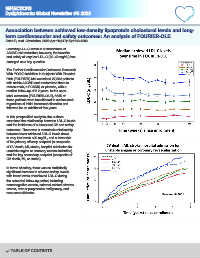
     In this prespecified analysis, the authors
     examined the relationship between LDL-C levels
     and the incidence of subsequent CV and safety
     outcomes. There was a monotonic relationship
     between lower achieved LDL-C levels down
     to very low levels <20 mg/dL, and a lower risk
     of the primary efficacy endpoint (a composite
     of CV death, MI, stroke, hospital admission for
     unstable angina or coronary revascularization)
     and the key secondary endpoint (composite of
     CV death, MI, or stroke).


     In terms of safety, there was no statistically
     significant increase in adverse safety events
     with lower levels of achieved LDL-C during
     the extended follow-up period, including
     neurocognitive events, cataract-related adverse
     events, new or progressive malignancy, and
     new-onset diabetes.


          TABLE OF CONTENTS

